
Part V: The Volatility Era – Olympic Struggles & The Path to 2026 (2018–Present)
If the previous era (Part IV 1998–2014) was a blockbuster movie, the “Volatility Era” felt like an indie film that only the die-hards watched.
In 2018, the NHL and the IOC failed to reach an agreement on insurance and travel costs, ending a run of five consecutive “best-on-best” tournaments. The league stayed home. Then, in 2022, just as a return seemed imminent, the COVID-19 pandemic forced the NHL to pull out again at the last minute.
This “Volatility Era” is controversial. Many fans argue that the medals won during this period come with an asterisk because the McDavids and Matthews of the world weren’t there. But I disagree. These tournaments were a throwback to the grit of the pre-1998 era. They gave us unlikely heroes, the rise of European leagues, and arguably the most technically sound team Finland has ever produced.
| Year | Host City, Country | 🥇 Gold | 🥈 Silver | 🥉 Bronze |
| 2018 | PyeongChang, South Korea | OAR (Russia) | Germany | Canada |
| 2022 | Beijing, China | Finland | ROC (Russia) | Slovakia |
Table of Contents
I. The Volatility Era Begins with the NHL Withdrawal (2018)
To understand why the NHL skipped PyeongChang, you have to follow the money. For five consecutive Olympics (1998–2014), the arrangement was simple: the NHL lent its players to the IOC, and in return, the IOC (along with the International Ice Hockey Federation) covered the costs of travel and insurance.
In 2017, that deal collapsed.
The “Tipping Point”: The Check The breaking point was the bill. Insuring billions of dollars’ worth of player contracts against injury is expensive. In previous years, the IOC covered these premiums. However, for 2018, the IOC—under President Thomas Bach—refused to pay, arguing that professional commercial leagues should subsidize their own athletes.
- The NHL’s Stance: Commissioner Gary Bettman and the team owners were furious. Their argument was transactional: We are shutting down our business for 17 days, risking our assets (players), and pausing our revenue stream. Why should we also pay for the privilege?
- The “Tavares” Factor: The owners’ fear wasn’t theoretical. In 2014, New York Islanders superstar John Tavares suffered a season-ending knee injury while playing for Canada. The Islanders’ season collapsed, they missed the playoffs, and the owner still had to pay Tavares’ salary. This incident became the “bloody shirt” owners waved to justify staying home.
The Geography Problem: The location mattered. NHL owners see the Olympics as a marketing tool.
- 2010 (Vancouver) & 2002 (Salt Lake): Great for business because games aired live in North American prime time.
- 2018 (South Korea): The time difference meant games aired at 3:00 AM in New York. Owners argued they gained zero marketing exposure from a tournament their customers were asleep for.
The Player Revolt: The players were devastated. Alex Ovechkin (Russia) famously declared he would go to PyeongChang regardless of the NHL’s decision, creating a brief standoff with his club, the Washington Capitals. Ultimately, the IIHF (international federation) sided with the NHL, stating they would not allow players to participate without valid transfer cards, effectively blocking Ovechkin and others from going rogue.
II. 2018 PyeongChang: The “Renegade” Gold
Dates: Feb 14–25, 2018
Venue: Gangneung Hockey Centre (Gangneung, South Korea)
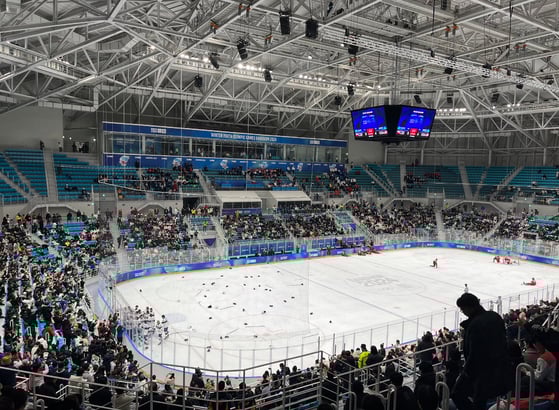
With the NHL gone, the tournament favorite was undeniably the Olympic Athletes from Russia (OAR). Because the KHL (Russia’s pro league) paused its season, the OAR team was essentially the Russian National Team in disguise, featuring legitimate stars like Pavel Datsyuk and Ilya Kovalchuk.
The “Miracle” That Almost Was: The story of this tournament wasn’t Russia; it was Germany.
- The Upset: In the semi-finals, Germany shocked Canada 4–3, preventing the Canadians from reaching the final for the first time since 2006.
- The Final: Germany was 56 seconds away from the greatest upset in hockey history. They led the Russians 3–2 late in the third period.
- The Heartbreak: With the OAR on a power play and their goalie pulled, Nikita Gusev scored a seemingly impossible angle shot to tie the game.
- The Overtime: In OT, Kirill Kaprizov (who would later become an NHL superstar for the Minnesota Wild) scored the Golden Goal. The Russians won 4–3.
The Anthem: Because of the state-sponsored doping scandal, the Russian team was banned from displaying their flag or hearing their anthem. However, as the Olympic anthem played during the medal ceremony, the players famously sang the Russian anthem over it, their voices drowning out the speakers.
III. 2022 Beijing: The Finnish Fortress
Dates: Feb 9–20, 2022
Venue: National Indoor Stadium (Beijing, China)
The 2022 Games were supposed to be the return of the NHL. But in December 2021, the Omicron variant of COVID-19 caused mass game cancellations across North America. The NHL invoked a “material change” clause and withdrew weeks before the Opening Ceremony.
The “Lions” Roar: While Canada and the USA scrambled to find players (resorting to college kids and aging pros again), Finland was ready.
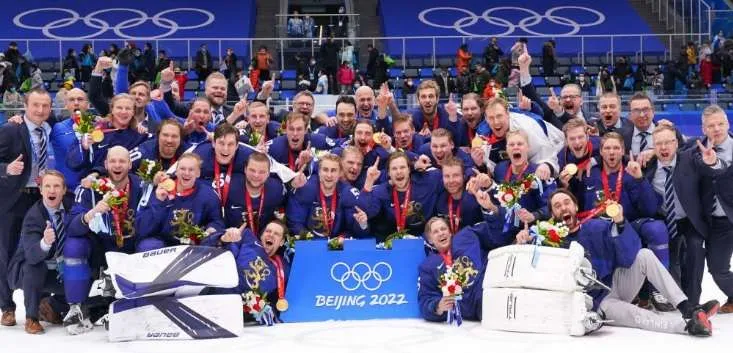
- The System: Finnish coach Jukka Jalonen had spent years building a system that didn’t rely on superstars. He used players from the domestic Finnish Liiga and the KHL who had played together for years.
- The Dominance: Finland went undefeated (6-0-0). They didn’t blow teams out; they strangled them. They allowed only 8 goals in the entire tournament.
- The Final: They faced the Russian Olympic Committee (ROC). Despite falling behind 1–0 on a dazzling goal by Mikhail Grigorenko, the Finns never panicked. They ground the Russians down, winning 2–1 to capture the first Olympic Gold in Finnish history.
- The Significance: For a nation of only 5.5 million people, this was the culmination of a 30-year project to become a hockey superpower.
IV. The “Best-on-Best” Drought
The eight-year gap between 2014 and the return in 2026 created a massive hole in the history books. We didn’t just miss tournaments; we missed specific, unrepeatable player arcs.
The “Torch Pass” That Never Happened: In hockey history, there is a tradition of the “old King” playing with the “new King.” In 1987, Wayne Gretzky played with Mario Lemieux. In 2002, Lemieux played with Jarome Iginla.
- The McDavid/Crosby Gap: The 2018 or 2022 Games were supposed to be the moment where Sidney Crosby (the aging legend) passed the torch to Connor McDavid (the young phenomenon). Fans dreamed of seeing them on the same power play. Because of the NHL’s absence, we likely missed the only window where their primes overlapped. That said, despite Crosby being nearly 39, he still has been playing sensational hockey throughout the 2025/26 regular season.
The Wasted “Golden Age” of USA Hockey: The cruelest irony of the drought is that it coincided with the greatest explosion of American talent in history.
- The Matthews Era: In 2018 and 2022, Auston Matthews was evolving into the best goal scorer on the planet.
- The Depth: The US could have fielded a roster featuring Patrick Kane, Jack Eichel, the Tkachuk brothers (Matthew and Brady), Quinn Hughes, and Adam Fox. Analysts universally agree that 2022 would have been the first time since 1996 that the USA would have entered a tournament as equal favorites to Canada. Instead, this “Golden Generation” sat at home.
The 2022 “Omicron” Heartbreak: What makes 2022 particularly painful is how close it came to happening.
- The Setup: The NHL and players had actually signed a Collective Bargaining Agreement (CBA) in 2020 that guaranteed Olympic participation. The jerseys were designed. The “Long Lists” (preliminary rosters) were submitted to the IOC.
- The Collapse: In December 2021, just six weeks before the Opening Ceremony, the Omicron variant of COVID-19 tore through the NHL. Over 50 games were postponed in a single month. The NHL invoked a “material disruption” clause in the agreement to pull out, needing the February Olympic break to make up the postponed regular-season games. It was a logistical necessity, but an emotional gut-punch to the players.
The “Fake” Substitutes: During this drought, the NHL tried to fill the void with the 2016 World Cup of Hockey. While the hockey was excellent, the format was widely criticized for being gimmicky. It featured a “Team North America” (players under 23) and a “Team Europe” (players from smaller nations). While fun, it lacked the nationalistic fervor of the Olympics, proving that you can manufacture a tournament, but you can’t manufacture prestige.
V. The Path to 2026: Milano Cortina
Dates: Feb 6–22, 2026
Host: Milan & Cortina d’Ampezzo, Italy
*Update (Feb. 22, 2026): Team USA defeats Canada 2-1 in overtime, taking home the gold for the first time in 46 years in one of the most incredible games the sport of hockey has ever seen.
Before Milan, the NHL staged its own mini-tournament to test the waters. The 4 Nations Face-Off (Canada, USA, Sweden, Finland) was the first “best-on-best” hockey in a decade.
- The Narrative: The tournament was designed to showcase the USA’s “Golden Generation.” The Americans, led by captain Auston Matthews, were faster and more skilled than any US team in history.
- The Reality Check: In the final, Canada dragged the Americans into a grinding, physical game. The score was tied 2–2 going into overtime.
- The Moment: Connor McDavid, playing on a line with Sidney Crosby for the first time, buried the OT winner. It was a signal to the world: Canada’s grip on the crown had not slipped.
The drought is officially set to end. In February 2024, the NHL, NHLPA, and IIHF announced a formal agreement to return to the Olympics for 2026 and 2030.
The 2026 Olympic rosters have sparked the fiercest debates in modern hockey history. The philosophy for both North American teams has shifted from “All-Star Teams” to “Constructed Rosters.”
Team USA:
For the first time since 1996, the United States enters the Olympics with a roster that matches Canada’s talent pound-for-pound.
- The Core: The team is built around the 2019–2021 draft classes. Auston Matthews wears the “C,” supported by the Tkachuk brothers (Matthew and Brady) who bring a level of physical nastiness the US often lacked.
- The Defense: This is the best American blue line ever assembled, anchored by Quinn Hughes, Adam Fox, and Charlie McAvoy.
- The Goal: Anything less than Gold is considered a failure for this group.
Team Canada:
The Canadian roster selection for 2026 was ruthless. GM Doug Armstrong made it clear he wasn’t building a fantasy team; he was building a team to kill penalties and grind out 2–1 wins.
The Headlines:
- The Crosby/McDavid Era: Finally, Sidney Crosby (38) and Connor McDavid (29) are wearing the Maple Leaf together. Crosby was named Captain, with McDavid and Cale Makar as Alternates. Oh and they also have Nathan MacKinnon, arguably the best player in the league as of the 2025/26 NHL season.
- The “Youth” Shock: In a stunning move, Canada selected 19-year-old Macklin Celebrini (San Jose Sharks). Management cited his two-way defensive responsibility as the deciding factor.
The Snub: Connor Bedard
For the second year in a row (after missing the 4 Nations team), phenom Connor Bedard was left off the roster.
- The Reasoning: despite Bedard’s elite scoring numbers, management opted for “200-foot players” like Seth Jarvis and Anthony Cirelli.
- The Drama: When Brayden Point suffered a groin injury just weeks before the Games, the nation assumed Bedard would get the call. Instead, Canada named Seth Jarvis as the replacement, doubling down on their defensive philosophy.
- Other Notable Cuts: Mitch Marner made the team, but Sam Bennett and Mark Scheifele were left home, sparking outrage in Winnipeg and Florida.
| Feature | 🇨🇦 Team Canada | 🇺🇸 Team USA |
| Captain | Sidney Crosby (PIT) | Auston Matthews (TOR) |
| Philosophy | “Positional Perfection” (Two-way play prioritized) | “Speed & Skill” (Overwhelming offense) |
| Star Rookie | Macklin Celebrini (SJS) | None (Roster is prime-age veterans) |
| Biggest Snub | Connor Bedard (CHI) | Kyle Connor (WPG) |
| Goaltending | Binnington (STL) / Thompson (WAS) / Kuemper (LAK) | Connor Hellebuyck (Vezina Winner) + Oettinger (DAL) / Swayman (BOS) |
VI: Women’s Golden Rivalry Continues (2018–2026)
If the Men’s tournament was defined by who wasn’t there, the Women’s tournament was defined by the fact that the best players in the world never took a shift off. This era saw the Canada-USA rivalry reach a fever pitch, culminating in the creation of a unified professional league (the PWHL) that has fundamentally changed the 2026 Games.
1. 2018 PyeongChang: The Drought Ends
The Stakes: Coming into 2018, Team USA had not won Olympic Gold since 1998. For 20 years, they had watched Canada celebrate. The Americans were faster and younger, but Canada had the psychological edge, having won four straight Golds.
Women’s Medal Table (2018–2022)
| Year | Host | 🥇 Gold | 🥈 Silver | 🥉 Bronze |
| 2018 | PyeongChang | USA | Canada | Finland |
| 2022 | Beijing | Canada | USA | Finland |
The Game: The Gold Medal Final was a defensive masterpiece that ended tied 2–2 after overtime. It went to a shootout—a cruel way to decide a 20-year war.
- The Move: In the sixth round of the shootout, American forward Jocelyne Lamoureux-Davidson pulled off a move she called “Oops, I Did It Again.” She faked a shot, dragged the puck to her backhand, and slid it past Canadian goalie Shannon Szabados while the goaltender was completely frozen.
- The Save: American goalie Maddie Rooney (just 20 years old) then stopped Canadian legend Meghan Agosta to seal the victory. The image of the Americans throwing their sticks and gloves in the air remains the defining image of US Women’s Hockey.
2. 2022 Beijing: The “Captain Clutch” Show
The Stakes: Canada entered 2022 on a mission of redemption. They had spent four years stewing over the shootout loss.
- The Record Breaker: While the focus was on the veterans, Canadian forward Sarah Nurse quietly had the greatest tournament in history. She set a new Olympic record with 18 points (5 goals, 13 assists), breaking the record previously held by Hayley Wickenheiser.
- The Final: Canada jumped out to a 3–0 lead in the Gold Medal game. The USA fought back to make it 3–2, but they couldn’t overcome the deficit.
- The Hero: Marie-Philip Poulin (“Captain Clutch”) scored two goals in the final. This made her the only player—male or female—to score in four consecutive Olympic Gold Medal games (2010, 2014, 2018, 2022).
3. The PWHL Revolution (2024–Present)
The biggest story of the 2026 Olympics isn’t what happened at the Games, but what happened between them.
- The Shift: In 2023, the messy landscape of women’s leagues (CWHL, PHF) finally unified into the Professional Women’s Hockey League (PWHL).
- The Impact: For the first time in history, the 2026 Olympic rosters are comprised almost entirely of full-time professional athletes. Players like Taylor Heise (USA/Minnesota Frost) and Sarah Fillier (Canada/New York Sirens) arrived in Milan not as college grads or centralized amateurs, but as seasoned pros playing a 30+ game physical season.
4. 2026 Milan: The Trilogy Fight
*Update (Feb. 22, 2026): Similar to the men’s outcome, women’s Team USA defeats Canada 2-1 in overtime, taking home the gold for the first time since 2018 in a stunning fashion. Well done ladies!
The 2026 tournament is viewed as the “rubber match” of this modern trilogy.
- Team USA: Led by Hilary Knight (playing in her likely final Olympics) and the explosive speed of Taylor Heise. The US game plan is built on transition speed that Canada historically struggles to match.
- Team Canada: Led by Marie-Philip Poulin and Sarah Nurse. Canada remains the heavy favorite due to their depth at center and the goaltending of Ann-Renée Desbiens.
- The Gap: The rest of the world is improving, but the gap remains. Czechia (led by PWHL stars) and Finland are fighting for Bronze, but the Gold is still a two-horse race.
Final Thoughts
The period from 2018 to 2024 will likely be remembered as the “Intermission.” It was a frustrating time for fans who craved the star power of the NHL, but it was a vital time for the global game. It proved that nations like Germany, Switzerland, and Finland could produce world-class teams without relying on North American leagues.
However, if you ask me, the appetite for 2026 is voracious. The hockey world has been denied a true “Best vs. Best” for 12 years. When the puck drops in Milan, it won’t just be a tournament; it will be a reunion. I can’t wait.

Did you miss the original articles kicking off my ‘Olympic Hockey Era’ series ? Don’t worry, you can find them all here:
Hockey’s Olympic History: Tracking Olympic Hockey From 1920 to Current Day
Part I: The Great Inception – When Ice Hockey Was an Olympic Summer Sport (1920–1924)
Part II: The Era of Canadian Olympic Dominance (1928–1952)
Part III: The Red Machine – The Soviet Dynasty & The “Amateur” Lie (1956–1988)
Part IV: The Dream Teams – The Olympic Modern Era & NHL Expansion (1992 -2014)
FAQs: The Volatility Era
Q: Who are the “Olympic Athletes from Russia” (OAR) and “ROC”? A: Due to state-sponsored doping scandals, Russia was technically banned from the 2018 and 2022 Olympics. However, “clean” Russian athletes were allowed to compete under neutral names:
- 2018: Olympic Athletes from Russia (OAR)
- 2022: Russian Olympic Committee (ROC) – They wore neutral colors and the Olympic anthem played if they won.
Q: Did the USA win a medal in this era? A: No. Without their NHL stars, the USA struggled.
- 2018: Lost in Quarterfinals to Czech Republic (Finished 7th).
- 2022: Lost in Quarterfinals to Slovakia (Finished 5th). The US development model relies heavily on the NHL, so they are hit hardest when the league withdraws.
Q: Who was the MVP of 2018? A: Ilya Kovalchuk (OAR). The former NHL star (and future Hall of Famer) was the emotional leader of the Russian team, scoring critical goals and finally winning the Gold Medal that had eluded him for his entire career.
Q: Why was Germany so good in 2018? A: It was a perfect storm. Their coach, Marco Sturm, built a system that maximized their speed. Additionally, the German domestic league (DEL) is strong, so their players were professional, conditioned, and had chemistry, whereas the Canadian and American teams were thrown together weeks before the tournament.
Q: Why was Connor Bedard left off the team? A: Canada’s management, led by Doug Armstrong, prioritized defensive reliability (“200-foot game”) over pure scoring. They felt that with McDavid, MacKinnon, and Crosby, they had enough offense. They viewed Bedard as a defensive liability compared to players like Seth Jarvis or Anthony Cirelli, who are elite penalty killers.
Q: Did Russia play in 2026? A: No. The IIHF extended the ban on Russia and Belarus for the 2025–2026 season due to the ongoing geopolitical situation. This means stars like Alex Ovechkin, Nikita Kucherov, Kirill Kaprizov, and Andrei Vasilevskiy are absent, significantly weakening the field.
Q: Who is the “Dark Horse” in 2026? A: Sweden. While all eyes are on North America, Sweden’s defense is stacked. Led by Victor Hedman and Rasmus Dahlin, they have the ability to shut down the high-flying American offense.
Q: Is this Sidney Crosby’s last Olympics? A: Almost certainly. At 38, he is playing the role of the “elder statesman.” He has explicitly stated that his goal is to hand the Captaincy to McDavid on the podium—ideally with a Gold Medal around his neck.
Q: Who is the best women’s player of this era? A: Marie-Philip Poulin (Canada). While the USA has incredible depth, Poulin is universally recognized as the best “big game” player in history. Her ability to score in Gold Medal games is a statistical anomaly.
Q: Did the NHL withdrawal affect the Women? A: No. The women’s tournament was the marquee hockey event in 2018 and 2022 because the NHL men were absent. TV ratings for the Women’s Gold Medal games often rivaled or beat the Men’s games in North America.
Q: What is the “Oops I Did It Again” goal? A: It refers to the shootout move used by Jocelyne Lamoureux in 2018 to win Gold. She practiced the move—a triple deke that forces the goalie to stretch out—thousands of times before using it to end the 20-year US drought.
Q: Are body checks allowed for women in 2026? A: Technically, no “open ice hits” are allowed, but the PWHL has normalized a much more physical style of play (pinning, battling) which has carried over to the Olympics. The 2026 games are significantly rougher than 2010.


